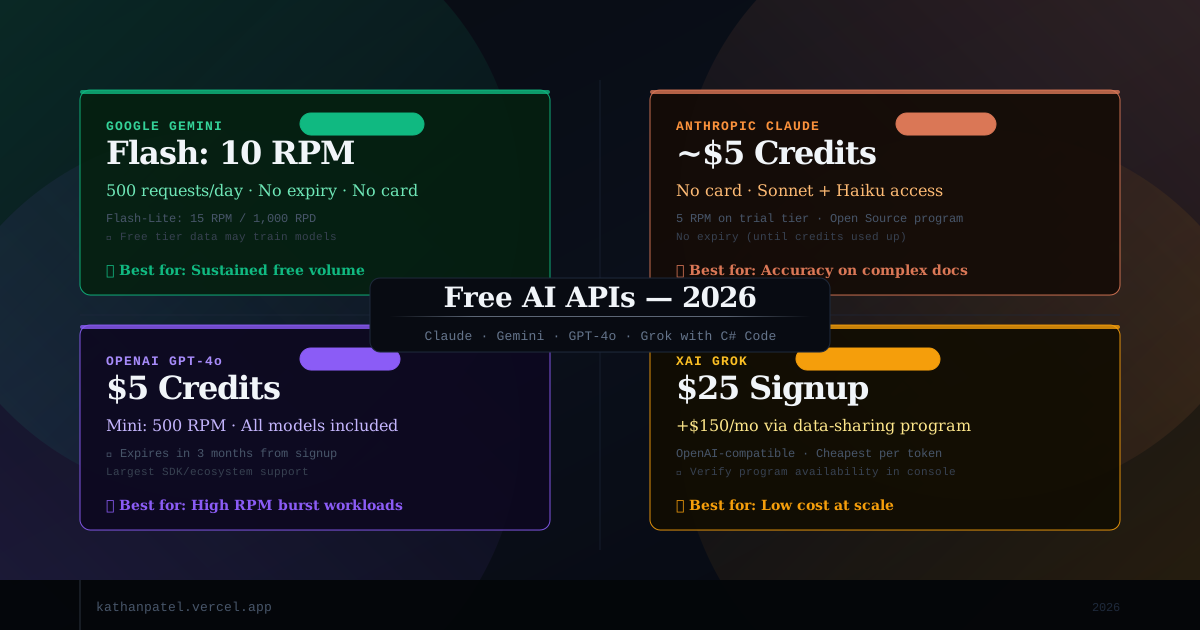
Every developer I know eventually Googles the same thing: "Claude API free tier". Usually right after they've played around with claude.ai, realised it can actually do the thing they need, and wondered how much it'd cost to wire it into a project. So let me save you the next 45 minutes of tab-hopping across documentation pages. This is the complete, honest answer to getting Claude API access without paying upfront what actually exists, what it gets you, and where the walls are.
The short version: Anthropic does not offer a permanent free API tier the way Google does with Gemini. But there are three legitimate paths to free Claude access depending on who you are and what you're building. Understanding which one applies to you is the whole point of this post.
The Three Free Paths Pick the Right One First
Path 1 The free trial credits (~$5, no credit card): Create a new account at console.anthropic.com and Anthropic drops roughly $5 in API credits into your account automatically. No card required. This works with every model including Sonnet 4.6 and gives you a real taste of the API before you commit to anything. The catch: it expires, and it's not a lot of runway at flagship model rates.
Path 2 The claude.ai free chat tier (permanent, no API): If you don't need programmatic access and just want to use Claude in a browser, the free tier on claude.ai is permanent. You get rolling usage windows, access to the standard Claude model, memory features, and file uploads. This is not API access you can't call it from code but it's useful for prototyping prompts before you spend credits testing them.
Path 3 Claude for Open Source (6 months of Max 20x, free): If you maintain an open source project with 5,000+ GitHub stars or 1M+ monthly npm downloads, Anthropic launched a program in February 2026 giving qualifying maintainers six months of Claude Max 20x free. That's their $200/month plan. Apply even if you're slightly under the threshold packages that are critical infrastructure with high downstream usage have been accepted.
Setting Up the Anthropic Console Step by Step
Go to console.anthropic.com. Create an account with your email no card prompt during signup. Once your email is verified, the credits are there. Go to Settings → API Keys and click Create Key. Copy the key immediately Anthropic only shows it once. Store it in an environment variable, never in source code.
One thing worth knowing: Anthropic separates your claude.ai subscription (for the chat interface) from your API account (for programmatic access). They use the same login but separate billing. A Pro subscription to claude.ai does not give you API credits they're two completely different products.
Your First API Call in C# No SDK Required
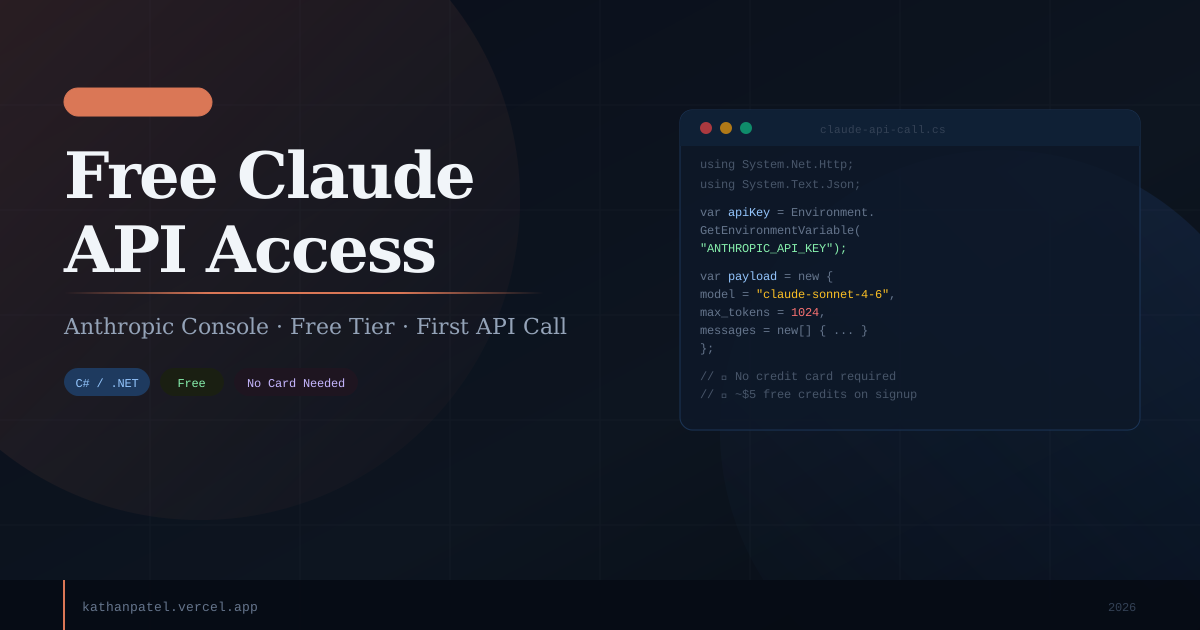
You don't need an external package to get started. The Anthropic API is straightforward REST standard HttpClient is all you need for a first call. Here's the minimal working example:
using System.Net.Http;
using System.Text;
using System.Text.Json;

// Store your key in an environment variable never hardcode it
var apiKey = Environment.GetEnvironmentVariable("ANTHROPIC_API_KEY")
    ?? throw new InvalidOperationException("ANTHROPIC_API_KEY not set");

using var client = new HttpClient();
client.DefaultRequestHeaders.Add("x-api-key", apiKey);
client.DefaultRequestHeaders.Add("anthropic-version", "2023-06-01");

var payload = new
{
    model = "claude-sonnet-4-6",   // Sonnet 4.6 best balance of cost and quality
    max_tokens = 1024,
    messages = new[]
    {
        new { role = "user", content = "Explain API rate limiting in one paragraph." }
    }
};

var json    = JsonSerializer.Serialize(payload);
var content = new StringContent(json, Encoding.UTF8, "application/json");

var response = await client.PostAsync("https://api.anthropic.com/v1/messages", content);
response.EnsureSuccessStatusCode();

var result = await response.Content.ReadAsStringAsync();
using var doc = JsonDocument.Parse(result);

var text = doc.RootElement
    .GetProperty("content")[0]
    .GetProperty("text")
    .GetString();

Console.WriteLine(text);

// Response shape for reference:
// {
//   "id": "msg_01...",
//   "type": "message",
//   "role": "assistant",
//   "content": [{ "type": "text", "text": "..." }],
//   "model": "claude-sonnet-4-6",
//   "stop_reason": "end_turn",
//   "usage": { "input_tokens": 14, "output_tokens": 87 }
// }
If you want a proper SDK with typed models, retry logic, and streaming support, the community-maintained Anthropic.SDK NuGet package is the main option for .NET. Install it with dotnet add package Anthropic.SDK. For most production projects, using it is cleaner than managing the raw HTTP calls yourself but for getting started, the HttpClient approach above does the job with zero dependencies.
What Your ~$5 in Credits Actually Gets You
The credits work across all models, so your burn rate depends entirely on which one you pick. Here's the practical breakdown:
The practical advice: test with Sonnet, prototype with Haiku. Haiku 4.5 is fast, cheap, and more capable than most developers expect. Use it for anything that doesn't need complex multi-step reasoning. Save Sonnet for the tasks where quality actually matters during your evaluation. Opus is there when you need it, but $5 doesn't go far at those rates reserve it for understanding the ceiling of what Claude can do before committing to a use case.
Rate Limits on Free Trial Credits What to Expect
Free trial credit accounts start at Anthropic's lowest usage tier. As of mid-2026, the practical limits are approximately 5 RPM (requests per minute) for Sonnet models meaning you can make one request every 12 seconds. Token-per-minute limits are more generous and rarely the bottleneck for development use. The per-day limit is also restricted, though Anthropic doesn't publish exact numbers publicly.
What this means practically: fine for building and testing, not fine for anything with real user traffic. If you're running a script to batch-process documents, add a delay between calls or you'll hit 429 errors constantly. Polly handles this well in .NET exponential backoff with jitter is the right pattern here.
// Handling rate limits with Polly add package: dotnet add package Polly
using Polly;
using Polly.Extensions.Http;

// Retry policy: up to 3 retries with exponential backoff + jitter
// Handles 429 (rate limit) and 529 (overloaded) responses
var retryPolicy = HttpPolicyExtensions
    .HandleTransientHttpError()
    .OrResult(r => r.StatusCode == (System.Net.HttpStatusCode)429)
    .WaitAndRetryAsync(
        retryCount: 3,
        sleepDurationProvider: (retryAttempt, response, _) =>
        {
            // Honour the Retry-After header if present
            var retryAfter = response?.Result?.Headers?.RetryAfter?.Delta;
            return retryAfter ?? TimeSpan.FromSeconds(Math.Pow(2, retryAttempt)
                + new Random().NextDouble());  // jitter
        },
        onRetryAsync: (outcome, timespan, retryAttempt, _) =>
        {
            Console.WriteLine($"Rate limited. Retry {retryAttempt} in {timespan.TotalSeconds:F1}s");
            return Task.CompletedTask;
        }
    );

// Attach to HttpClient
var handler   = new HttpClientHandler();
var pollyClient = new HttpClient(new PolicyHttpMessageHandler(retryPolicy) { InnerHandler = handler });
pollyClient.DefaultRequestHeaders.Add("x-api-key", apiKey);
pollyClient.DefaultRequestHeaders.Add("anthropic-version", "2023-06-01");

// Use pollyClient the same way rate limit handling is now automatic
Tips to Stretch Your Free Credits Further
A few things that actually move the needle when you're working within the $5 budget:
Set max_tokens conservatively. Every token in the response costs money. If you're extracting structured data, you don't need 4,096 output tokens the JSON you want is probably 200–400 tokens. Setting max_tokens = 400 caps your output cost and often has no effect on quality for extraction tasks.
Test prompts on Haiku before running on Sonnet. Haiku is roughly 4–5x cheaper and handles most common tasks well. Build your prompt on Haiku until the output is right, then verify on Sonnet. You'll burn through far less budget during iteration.
Use system prompts to cut input tokens on repeated calls. If you're making many similar calls (like processing a batch of documents), a well-structured system prompt that sets the context once is more efficient than repeating instructions in every user message. Prompt caching (available on paid tiers) takes this further, but even without it, consistent concise instructions keep input tokens lower.
Monitor your usage in the Anthropic Console under Settings → Billing → Usage. You can see token consumption per model and per API key. Don't guess watch the actual numbers.
When the Free Credits Run Out What Upgrading Looks Like
Once your trial credits are used, you'll need to add a payment method and deposit a minimum of $5 to move to Tier 1. This unlocks higher rate limits (50 RPM for Sonnet) and removes the trial restrictions. From there it's pay-per-use no monthly minimum, no subscription required. You spend $10, you get $10 of API calls.
At most reasonable development volumes, the cost is genuinely small. If you're building a document processing tool or a personal project that handles a few hundred requests per day, you're looking at a few dollars a month on Sonnet. The point where Claude API costs become a real budget consideration is production scale and by then you'll have a clearer picture of your actual token usage.
One last thing worth knowing before you go: the $5 trial credits don't have a specific expiry date listed in the console, but they're meant for evaluation not for parking a project on free access indefinitely. Use them to build something real, see if Claude does what you need, and make a proper decision from there. For most .NET developers building document extraction, chatbots, or content pipelines, the math is straightforward: the cost is low enough that the real decision is capability and API reliability, not price.
Have Thoughts? Let's Talk.
If you ran into something this post didn't cover, found the limits different from what I've described, or are building something on Claude and want to compare notes I'd genuinely like to hear about it.
💬 Start a Discussion →
Opens your email client with my address pre-filled. No tracking, no funnel just a real conversation.